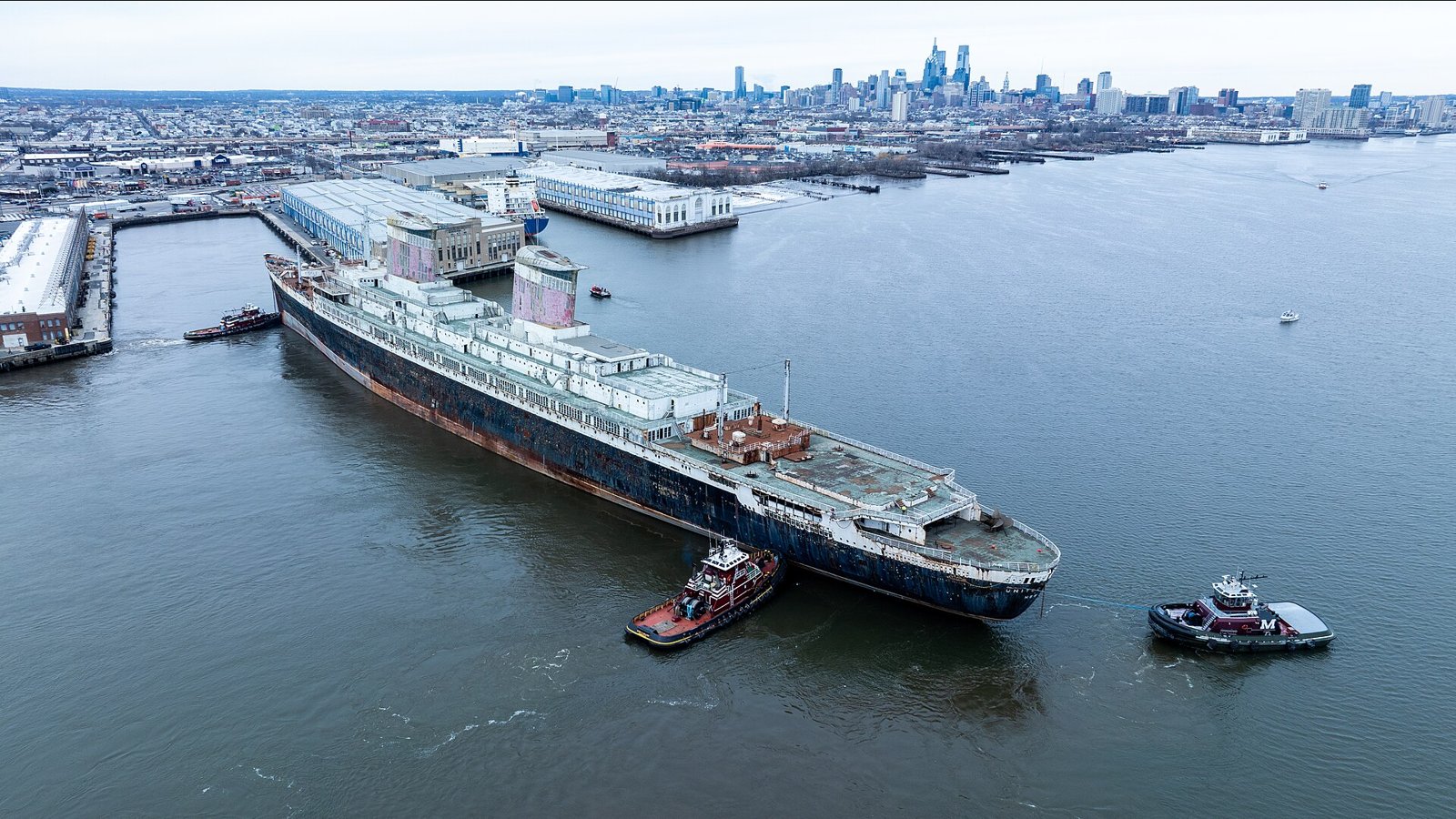
The SS United States, the fastest ocean liner ever built, now sits on the floor of the Gulf of Mexico about 22 nautical miles southwest of Destin-Fort Walton Beach, Florida, in roughly 180 feet of water. Okaloosa County sank the 990-foot ship on Wednesday, Nov. 11, 2026, to create what officials call the world’s largest artificial reef. Its upper deck was planned to sit about 55 feet down, within reach of certified recreational divers, and the county said divers could start visiting from dawn on Nov. 12. Here’s where the wreck is, how deep it is, what diving it involves and what non-divers can look forward to.
What happened to the SS United States?
The sinking began on the afternoon of Nov. 11 and took far longer than planned. Crews did not use explosives. Instead, they removed plugs and opened holes in the hull so the ship would flood in a controlled way, NPR reported. The liner finally slipped under after 9 p.m. local time, about eight hours later than expected, according to WUWF Public Media. Watch parties were held in Destin and Pensacola.
The county had moved the sinking up a day, from Thursday to Wednesday, to avoid forecast heavy winds and rough seas, the Pensacola News Journal reported.
Where exactly is the SS United States reef?
The wreck lies about 22 nautical miles southwest of Destin-Fort Walton Beach and about 32 nautical miles southeast of Pensacola Pass. The county’s proposed deployment coordinates were 30° 07.148′ N, 86° 46.755′ W, but the final position is being confirmed after the sinking, the News Journal said.
The first divers on the wreck have a job to do. Teams from Destin-Fort Walton Beach and the Woods Hole Oceanographic Institution are surveying the ship to document exactly where and how it settled, and that information goes to the U.S. Army Corps of Engineers. That survey is a standard step whenever a large vessel is placed as a reef.
The ship now sits about 29 miles from the USS Oriskany, the 888-foot aircraft carrier the Navy sank off Pensacola in 2006, which held the “world’s largest artificial reef” title until this week. Together they give the Florida Panhandle the two biggest artificial reefs on Earth.
How deep is the wreck?
The water at the site is about 180 feet deep, Axios reported. Before the sinking, the ship’s smokestacks were removed so the top of the structure would sit shallower. Okaloosa County’s plan put the upper deck at about 55 feet, according to Scuba Diving magazine, with the open promenade deck below that and the seafloor where the propellers used to be at the bottom. Exact depths of each feature will depend on how the ship came to rest, so check the survey results before you plan a dive.
Can you dive the SS United States now?
Yes, if you’re a certified diver. Okaloosa County’s spokesperson, Nick Tomecek, told the News Journal that recreational divers were expected to be able to visit from dawn on Thursday, Nov. 12. Local charter operators started booking trips as soon as the date was set.
What certification do you need?
- Upper deck (about 55 to 60 feet): within recreational limits. One Destin operator, Shark Quest, asks for Open Water certification with recent dives.
- Hull and lower decks (down to about 180 feet): deep and technical diving, which needs advanced training, decompression planning and specialized gas for the deepest sections.
- Going inside: wreck penetration needs wreck training. Contractors sealed off compartments and lower areas considered unsafe, according to the News Journal and Axios.
Because the site is more than 20 miles offshore, expect open-Gulf conditions and currents. Shark Quest recommends nitrox and requires every diver to carry a surface marker buoy.
How much does an SS United States dive trip cost?
Prices vary by operator. As of Nov. 12, 2026, Shark Quest listed its SS United States trip at $300 for three dives, with its first charters on Nov. 14 and 15, and Emerald Coast Scuba listed $295 per person for a two-tank trip, with gear and tank rental extra. Spots on small boats are limited, and trips depend on weather, so book ahead and confirm what’s included.
If you’d rather stay on the surface, the same Destin waters are known for charter fishing, and a private fishing charter is another way to get out on the Gulf. The county expects fish such as red snapper, grouper and amberjack to move onto the wreck over time.
Why was the SS United States famous?
Launched in 1951, the SS United States was longer than the Titanic and crossed the Atlantic Ocean in less than four days. Over its career it carried four presidents, the Mona Lisa and a long list of 20th-century movie stars, NPR noted. It crossed the Atlantic more than 800 times, the Associated Press reported.
On its maiden voyage in July 1952, the liner won the Blue Riband for the fastest Atlantic crossing, making the eastbound trip in 3 days, 10 hours and 40 minutes at an average of 35.59 knots. It was designed by William Francis Gibbs, whose granddaughter Susan Gibbs leads the SS United States Conservancy. She told NPR her grandfather “loved this ship a thousand times more than my grandmother.”
The jet age ended the era of the great transatlantic liners, and the ship spent decades rusting at a pier in Philadelphia. Ideas to turn it into a hotel, restaurant or other attraction never got off the ground because of the cost. In 2024 it was evicted from Pier 82 over back rent, and the conservancy sold it to Okaloosa County for $1 million. The ship left Philadelphia in 2025 and spent more than a year in Mobile, Alabama, where crews stripped out toxic materials and bulky components to make it safe as a reef.
What did it cost, and why sink a ship on purpose?
The county budgeted about $10 million for the project, and its tourism director, Jennifer Adams, told NPR she expects to earn that back in “a couple of years.” Axios put the cost of sinking the liner at at least $13.6 million, plus about $130,000 for security and watch boats.
The bet is on tourism. Okaloosa County has already sunk hundreds of artificial reefs, many of them ships and boats, and Adams said they bring in roughly $10 million to $12 million a year in economic benefits. Florida has created more than 4,000 artificial reefs since 1940, according to a state wildlife commission tally cited by NPR. Adams said the county is already planning “five or six” more reefs after this one.
Not everyone is sure the boom will last. University of Florida economist Andrew Ropicki told NPR that the Panhandle’s “critical mass” of wrecks helps it capture tourism dollars, but that too many reefs could eventually bring diminishing returns.
What about people who don’t dive?
Okaloosa County plans a land-based museum with artifacts from the ship, including its smokestacks, radar mast, propeller and anchor, according to Scuba Diving magazine. No opening date has been announced, so check with Destin-Fort Walton Beach tourism before you plan a trip around it.
If you love ocean travel more than wreck diving, there are still plenty of ways to go to sea. Our guide to choosing the best cruise for an unforgettable adventure covers how to pick a ship and itinerary, and if epic journeys are your thing, read how Karl Bushby finished his 28-year walk around the world without using transport to move forward.
FAQ
When was the SS United States sunk? On Wednesday, Nov. 11, 2026. It went fully under after 9 p.m. local time.
Where is the SS United States now? On the floor of the Gulf of Mexico, about 22 nautical miles southwest of Destin-Fort Walton Beach, Florida.
How deep is the SS United States reef? The water is about 180 feet deep. The upper deck was planned to sit about 55 feet below the surface, pending the post-sinking survey.
Is the SS United States the largest artificial reef in the world? Officials say yes. At 990 feet long, it is bigger than the 888-foot USS Oriskany off Pensacola, the previous record holder.
Can beginners dive the SS United States? Certified Open Water divers with recent experience can visit the upper deck with a charter. Deeper sections and going inside the ship need advanced or technical training.
How much did Okaloosa County pay for the ship? $1 million, paid to the SS United States Conservancy in 2024.
Sources: NPR; Associated Press; Pensacola News Journal; Axios; WUWF Public Media; Scuba Diving; Shark Quest; Emerald Coast Scuba. Charter prices and schedules are set by each operator and can change.
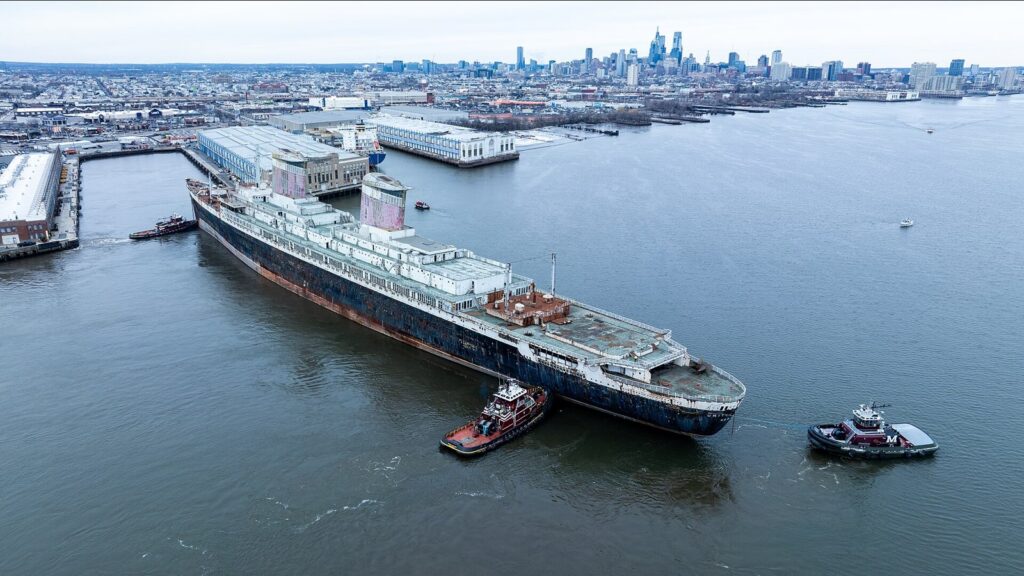
Featured image: the SS United States begins its tow out of Philadelphia, February 2025. Photo by WSRower via Wikimedia Commons, released under CC0 (cropped).