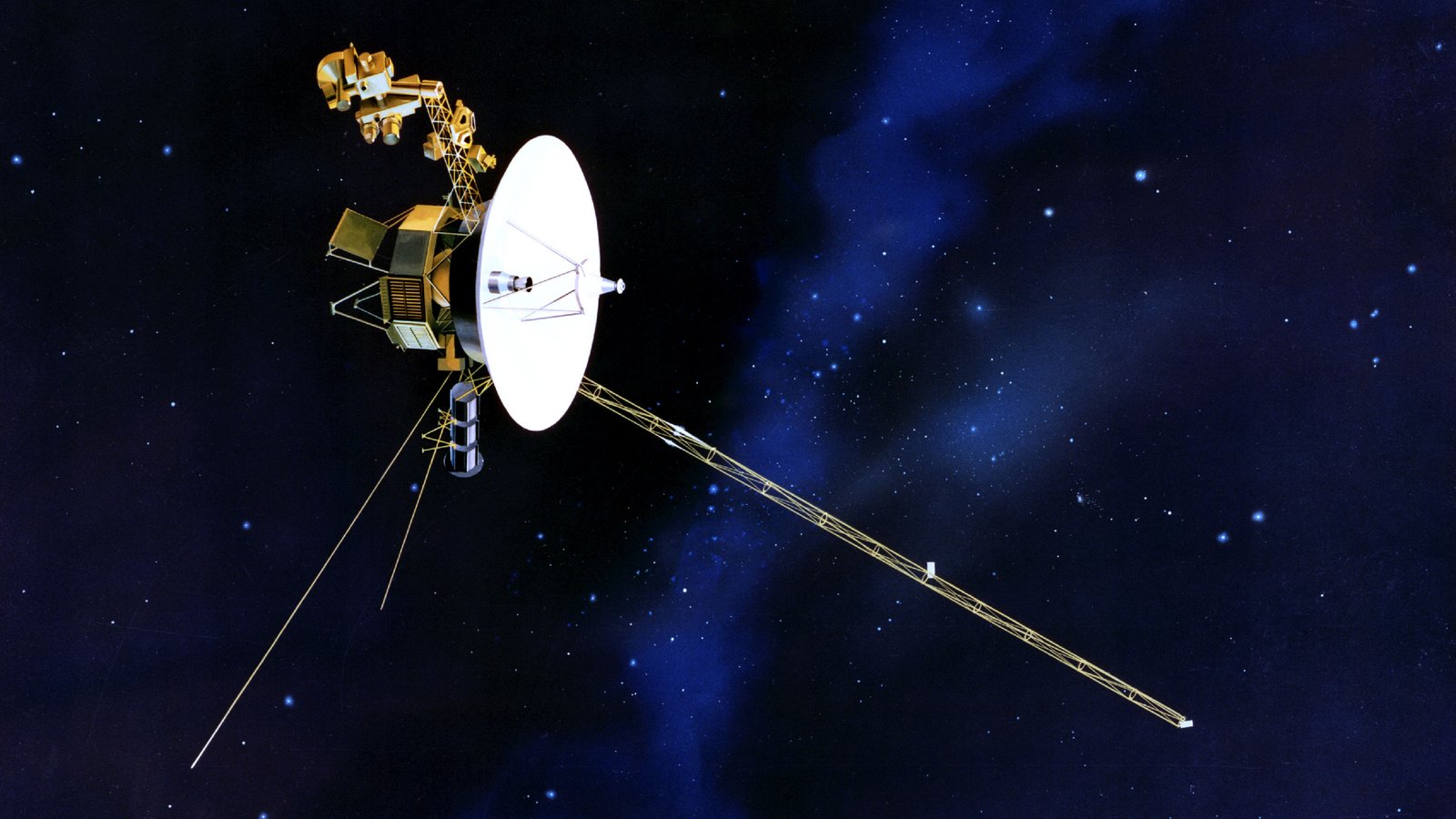
NASA’s Voyager 1 is now one light-day from Earth. At 5:16:07 a.m. EST (10:16:07 UTC) on Wednesday, Nov. 18, 2026, the spacecraft became the first human-made object to travel so far that light, and the radio signals NASA uses to talk to it, need a full 24 hours to make the trip one way. It took Voyager 1 49 years, two months and 11 days to get there, according to NASA.
Here’s what a light-day actually is, what the milestone means for the people still flying the mission, and how you can join the celebrations this week.
What is a light-day?
A light-day is a measure of distance, not time. It’s how far light travels in 24 hours. Light moves at about 186,000 miles per second, so one light-day works out to 16,094,799,096 miles (25,902,068,356 kilometers), NASA says. EarthSky puts it at about 173.14 astronomical units, or 173 times the distance between Earth and the Sun.
To put that in perspective: sunlight reaches Earth in a little over eight minutes. A signal to Voyager 1 now takes a whole day.
How fast is Voyager 1 going?
Voyager 1 is cruising at nearly 38,000 mph (61,000 kph). That’s blisteringly fast by human standards, but it’s a crawl compared with light, which is why it took almost five decades to cover a distance light crosses in a day.
Why the milestone matters for the Voyager team
NASA communicates with both Voyagers through the Deep Space Network, a set of giant radio dishes in California, Spain and Australia. Because radio waves travel at the speed of light, every conversation with Voyager 1 now has a two-day round trip.
“You need to have patience because now, if you send a command to Voyager, Voyager receives that command 24 hours later,” Voyager project scientist Linda Spilker told Space.com. “So two days later, you receive confirmation that yes, Voyager one received your command.”
NASA noted that the team won’t hear the spacecraft’s “return call” from the moment it crossed the line until the same time on Nov. 19. That’s also a reminder of something odd: if you could see Voyager 1 through a telescope today, you would be seeing it as it was a day ago.
Is Voyager 1 still working?
Yes. Both Voyagers are still in contact with Earth and still sending science data, but they run on a steadily shrinking power supply. Over the years, NASA has switched off one system after another to save energy. In April 2026, for example, the team turned off Voyager 1’s Low-Energy Charged Particle instrument, EarthSky reports, though it could be turned back on later.
Spilker told Space.com that the plan has always been to keep at least one type of instrument running on each spacecraft for as long as possible. The flight team is tiny, just eight to 10 people, and it regularly brings back retired Voyager veterans to share what they know.
How Voyager 1 got here: a quick timeline
- Aug. 20, 1977: Voyager 2 launches first.
- Sept. 5, 1977: Voyager 1 launches on a faster path, which is why it later pulled ahead of its twin.
- 1979: Voyager 1 flies past Jupiter. It discovers active volcanoes on the moon Io (the first eruptions ever seen on another world), a thin ring around Jupiter and the small moons Thebe and Metis.
- 1980: At Saturn, it finds new moons and a new ring, and shows that the large moon Titan has a thick atmosphere.
- 1990: Voyager 1 takes the first “family portrait” of the solar system, including the famous “Pale Blue Dot” image of Earth as a single speck of light.
- Aug. 25, 2012: It becomes the first human-made object to cross the heliopause and enter interstellar space. Voyager 2 follows in November 2018.
- Nov. 18, 2026: Voyager 1 reaches one light-day from Earth.
Space.com notes that while both probes have left the heliosphere (the Sun’s bubble of charged particles), they technically haven’t left the solar system, since they’re still within the Sun’s gravitational reach.
Where is Voyager 1 going next?
According to NASA, Voyager 1 is headed toward a star called AC +79 3888, also known as Gliese 445, which is more than 17 light-years from Earth. Don’t hold your breath: the spacecraft is expected to pass within about 1.7 light-years of it in roughly 40,000 years.
Both Voyagers also carry a Golden Record, a gold-plated disc of sounds and images from Earth meant as a message from humanity. They’ll keep drifting through the Milky Way long after they go silent.
When will Voyager 2 reach one light-day?
Not for a while. Voyager 2 took a longer “Grand Tour” past Jupiter, Saturn, Uranus and Neptune and is moving a bit slower. It isn’t expected to reach one light-day from Earth until November 2035, according to NASA via EarthSky.
How to celebrate Voyager 1’s light-day milestone
If you missed NASA’s “Shine Bright for Voyager’s Light-Day” event on the evening of Nov. 17, when people around the world flashed Voyager’s call sign “VGR” in Morse code at the sky, there’s still plenty to do this week:
- Watch NASA’s live discussion: On Thursday, Nov. 19, at 12 p.m. EST (9 a.m. PST), NASA’s Jet Propulsion Laboratory hosts a panel with Voyager project manager Suzanne Dodd, Linda Spilker and other mission leaders about the probes’ status and science. It includes a preview of a NASA+ Voyager documentary planned for 2027, the mission’s 50th anniversary. Streaming details are at NASA’s event page.
- Tune in to The Planetary Society: Its free livestream runs 7 to 8 p.m. CST on Wednesday, Nov. 18 (1 to 2 a.m. UTC Nov. 19) on YouTube, where space artist Don Davis is set to unveil a new illustration of Voyager 1 from one light-day away.
- Flash VGR anyway: In Morse code, V is dot-dot-dot-dash, G is dash-dash-dot and R is dot-dash-dot. It’s a symbolic gesture (no flashlight can reach the probe), but it’s a fun one to try with kids after dark.
- Track Voyager in real time: NASA’s “Where are Voyager 1 and Voyager 2 now?” page shows both probes’ live distances.
- Download the posters: NASA has released free one light-day posters and graphics on its Voyager downloads page.
If this week’s sky has you hooked, our guide to the Leonid meteor shower covers the best times to look up this month.
Turn it into a family science lesson
The light-day idea is easy to explain to kids: ask how long they think a “call” to Voyager takes, then show them it’s a full day each way. Pair it with a globe to show how tiny Earth is compared with that distance; our guide to globes for kids has ideas for getting started. You can also make an evening of it alongside other fun activities to do with kids in the city, like a planetarium visit.
FAQ
What time did Voyager 1 reach one light-day from Earth?
At 5:16:07 a.m. EST (10:16:07 UTC) on Nov. 18, 2026, according to NASA.
How far is one light-day?
About 16.09 billion miles (25.9 billion kilometers), the distance light travels in 24 hours.
How long does it take to send a message to Voyager 1?
About 24 hours one way, so roughly two days for a command to go out and a reply to come back.
Is Voyager 1 still sending data?
Yes. Several instruments have been turned off to save power, but Voyager 1 is still returning data from interstellar space.
When will Voyager 2 reach one light-day?
NASA expects Voyager 2 to reach that distance in November 2035.
Sources: NASA Science, NASA, NASA Scientific Visualization Studio, Space.com and EarthSky. Featured image: artist’s concept of the Voyager spacecraft, NASA/JPL, public domain via Wikimedia Commons.