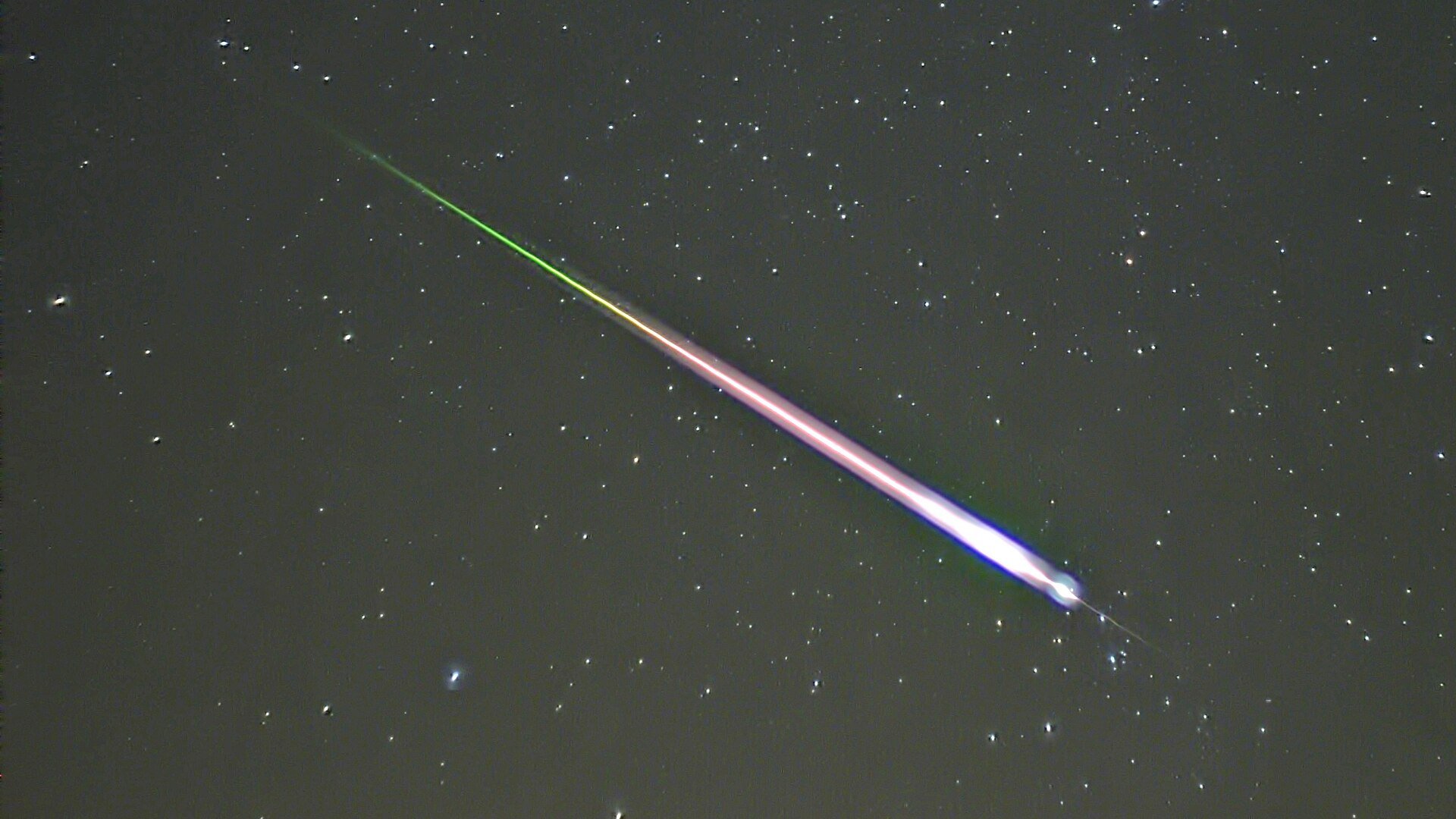
The Leonid meteor shower peaks on the night of Tuesday, Nov. 17, into the early hours of Wednesday, Nov. 18, 2026. The best window is after midnight until dawn, local time, and this year the timing is kind: the first quarter Moon sets around midnight, so the sky is dark for the hours that matter most. Under a dark sky, expect about 10 to 15 meteors an hour, plus a bonus view of Jupiter and Mars shining side by side right where the Leonids appear to come from.
Here is when to look, where to point your eyes, what to bring and why this modest shower is one of the most famous in history.
When is the Leonid meteor shower peak in 2026?
The American Meteor Society predicts the peak for 0:00 UTC on Nov. 18, according to EarthSky. That works out to 7 p.m. Eastern on Nov. 17, which is before the shower’s radiant rises for North American viewers, so the practical advice is the same everywhere: watch after midnight on the mornings of Nov. 17 and Nov. 18.
Farmers’ Almanac, puts the best stretch from midnight to about 5:30 a.m. local time on the night of Nov. 17 to 18. The Royal Observatory Greenwich gives UK viewers the same night, the evening of Nov. 17 into the early hours of Nov. 18.
Can I still see Leonids if I miss the peak?
Yes. Timeanddate lists the shower as active from Nov. 6 to 30, and EarthSky notes that Earth passes through the Leonid debris stream from Oct. 28 to Dec. 7. Rates are lower away from the peak, but a clear night this week can still turn up a few.
Will the Moon ruin the view?
Not this year, as long as you wait until after midnight. EarthSky puts first quarter Moon at 11:48 UTC on Nov. 17 (6:48 a.m. Eastern). A first quarter Moon sets around midnight, and Farmers’ Almanac says it will be a little over half lit on the peak nights but will set close to midnight on both, leaving the second half of the night dark. That second half is exactly when the Leonids are best, because their radiant in the constellation Leo only rises around midnight and climbs highest just before dawn.
How many meteors will you see?
Be realistic. The International Meteor Organization predicts a zenithal hourly rate of around 15 for 2026, per timeanddate, and no surge in activity is expected. EarthSky and Farmers’ Almanac both suggest 10 to 15 meteors an hour under ideal, dark, moonless skies. That is roughly one every four to six minutes, and fewer if you are near city lights.
What the Leonids lack in numbers they make up for in speed and brightness. They are among the fastest meteors, hitting the atmosphere at about 160,000 miles (260,000 kilometers) per hour, and they are known for bright, sometimes colorful streaks that can leave a glowing trail behind them for a moment or two.
Where to look: use Jupiter and Mars as your guide
You do not have to stare at one spot. Meteors appear all over the sky; they just seem to stream away from a single point, the radiant, inside Leo’s “Sickle,” a backwards question mark of stars. The Planetary Society points out that meteors farther from the radiant tend to look longer, and the most important thing is simply finding the darkest patch of sky you can.
In 2026 finding Leo is unusually easy. Jupiter and Mars sit close together right next to the radiant, rising in the east around midnight and standing highest before dawn, and EarthSky says the two planets are at their closest around Nov. 16, just as the shower peaks. Jupiter will be the brilliant one; Mars stands out for its reddish color. Timeanddate adds that, closer to sunrise on Nov. 18, Venus and Mercury join them low on the eastern horizon for a brief mini planet parade from the Northern Hemisphere.
Can you see the Leonids from the Southern Hemisphere?
Yes. The Leonids are visible from both hemispheres, though the Planetary Society says the view is somewhat better from the Northern Hemisphere because Leo climbs higher there.
How to watch the Leonids: a simple checklist
- Check the forecast. Clouds are the biggest spoiler. Look at the local forecast the day before and have a backup night (Nov. 16 to 17 or Nov. 18 to 19) in mind.
- Get away from lights. Farmers’ Almanac suggests driving 20 to 40 minutes outside the nearest city if you can. Parks, rural roads and open fields all work, as long as the spot is safe and legal to visit at night.
- Give your eyes 20 to 30 minutes. Your night vision needs time to adjust, and one glance at a bright phone screen resets the clock. Use a red-light setting or leave the phone in your pocket.
- Skip the telescope. Meteors move too fast for binoculars or a telescope. Your eyes are the right tool. (Binoculars are handy for the Jupiter and Mars pairing, though.)
- Lie back. A reclining chair, yoga mat or sleeping bag lets you take in as much sky as possible without a sore neck.
- Dress for winter. Mid-November nights can drop into the 20s and 30s Fahrenheit across much of the U.S. and Canada, so bring layers, a hat, gloves and a thermos of something warm.
If you have kids, the late hours are the tricky part. One option is setting an alarm for an hour or two before dawn on Nov. 18, when the radiant is high and the planets are lined up, and treating it as a short backyard adventure, much like the low-key outdoor activities that work for families in the city.
Why the Leonids are so famous
The Leonids come from debris shed by Comet 55P/Tempel-Tuttle, which orbits the Sun about once every 33 years. When Earth runs into a fresh, dense trail of that dust, the result can be a meteor storm, generally defined as more than 1,000 meteors an hour.
That is what happened on Nov. 12 to 13, 1833, often called “the night the stars fell,” when estimates suggest as many as 150,000 meteors an hour, according to EarthSky. On the morning of Nov. 17, 1966, observers in the southwestern U.S. reported up to 70 meteors per second for 15 to 20 minutes. More recent outbursts in 1999 and 2001 reached several thousand meteors an hour.
Timeanddate says the last Leonid storm was in 2002. The comet is due back in early 2031, and the International Meteor Organization predicts a potentially good display that year, but the next true storm is not expected until around 2099. So 2026 is an ordinary year for the Leonids, just a well-timed one.
Leonid meteor shower 2026: FAQ
What night is best to see the Leonids in 2026?
The night of Tuesday, Nov. 17, into Wednesday morning, Nov. 18. The morning of Nov. 17 (tonight into tomorrow for many readers) is also worth a look.
What time should I go outside?
After midnight local time, ideally in the hours before dawn begins to brighten the sky, when the radiant is highest. The Moon will have set and Leo will be well above the horizon.
Which direction should I face?
Start toward the east, where Leo and the bright Jupiter-Mars pair rise, then look up and around. Meteors can appear anywhere in the sky.
Do I need special equipment?
No. Just clear, dark skies, warm clothes and patience. If you are traveling somewhere remote this season, dark-sky spots like the Iceland hot springs known for stargazing and aurora views or the high-altitude stargazing on Maui make meteor watching even better.
Will 2026 be a Leonid meteor storm?
No. Astronomers do not expect a storm this year; a typical 10 to 15 meteors an hour is the forecast.
Featured image: A meteor during the peak of the 2009 Leonid meteor shower, photo by Navicore via Wikimedia Commons, CC BY 3.0 (cropped).