If it’s the day before Thanksgiving and your turkey is still a block of ice, you haven’t missed your chance. The fastest safe fix is the cold-water method: keep the bird sealed in a leakproof bag, submerge it in cold tap water, change the water every 30 minutes and allow about 30 minutes per pound, according to the USDA’s Food Safety and Inspection Service. A 16-pound turkey started Wednesday morning can be thawed by the afternoon. And if even that’s too late, USDA says you can roast a turkey straight from frozen. It just takes at least 50% longer. Here’s how each option works, how long it takes, and who to call if something goes wrong on Thursday.
Thanksgiving turkey rescue at a glance
- Fastest safe thaw: Cold water, about 30 minutes per pound, changing the water every 30 minutes. Cook right away.
- Slowest but easiest: Refrigerator, about 24 hours for every 4 to 5 pounds.
- No time at all: Cook from frozen at 325°F or higher and expect at least 50% more oven time.
- Never: Thaw on the counter, in the garage or on the porch.
- Done when: A food thermometer reads 165°F in the breast, wing and thigh.
- Butterball Turkey Talk-Line: 1-800-288-8372 or text 844-877-3456; open 6 a.m. to 6 p.m. Central on Thanksgiving Day.
- USDA Meat and Poultry Hotline: 1-888-674-6854; open 8 a.m. to 2 p.m. Eastern on Thanksgiving Day.
How long does it take to thaw a turkey?
That depends on the method and the weight. Here are the USDA’s estimates from its consumer guide to roasting a turkey.
| Turkey weight | In the refrigerator | In cold water |
|---|
| 4 to 12 pounds | 1 to 3 days | 2 to 6 hours |
| 12 to 16 pounds | 3 to 4 days | 6 to 8 hours |
| 16 to 20 pounds | 4 to 5 days | 8 to 10 hours |
| 20 to 24 pounds | 5 to 6 days | 10 to 12 hours |
Doing the math: anyone with a bird over 12 pounds who hasn’t started thawing in the fridge by Wednesday is too late for that method. The cold-water method is your best bet.
How to thaw a turkey in cold water
The cold-water method takes more hands-on work, but it’s the one that saves Thanksgiving for most late starters. The USDA and the Centers for Disease Control and Prevention describe the same steps:
- Keep the turkey in its wrapper and put it in a leakproof plastic bag. The CDC notes that the bag stops raw juices from spreading around your sink and keeps the meat from absorbing water.
- Submerge the whole bird in cold tap water, in a clean sink, cooler or large pot.
- Change the water every 30 minutes so it stays cold.
- Allow about 30 minutes per pound.
- Cook the turkey as soon as it’s thawed. A turkey thawed in cold water shouldn’t go back in the fridge to wait, and it shouldn’t be refrozen.
Warm or hot water is not a shortcut. The goal is to keep the outside of the bird cold while the inside thaws.
Can you thaw a turkey in the microwave?
Yes, if it fits. USDA says to check your microwave’s manual for the maximum size, minutes per pound and power level, remove all the outer wrapping, and set the bird on a microwave-safe dish. USDA says to cook it immediately afterward and not to refrigerate or refreeze it. In practice, this only works for smaller birds and turkey breasts.
Why you should never thaw a turkey on the counter
The CDC explains that once a turkey sits at room temperature for more than two hours, its outer layer becomes unsafe even if the center is still frozen. Germs multiply fastest in the “danger zone” between 40°F and 140°F. Raw turkey can carry Salmonella, Campylobacter and Clostridium perfringens, and the CDC says C. perfringens outbreaks happen most often in November and December. The agency also warns against storing a turkey somewhere you can’t monitor the temperature, like a car trunk, basement, back porch or snowbank.
Can you cook a turkey that’s still frozen?
Yes. The USDA says it’s safe to cook a turkey from frozen, as long as you plan for at least 50% more time than a fully thawed bird would need. So a 14- to 18-pound unstuffed turkey, which normally takes about 3¾ to 4¼ hours at 325°F, could need roughly 5½ to 6½ hours from frozen. Once the bird has thawed enough, carefully pull out the giblet package with tongs or a fork partway through cooking.
Don’t stuff a frozen or partly frozen turkey. Bake the stuffing separately in a casserole dish. That’s the method both USDA and the CDC say is safest anyway.
Turkey cooking times at 325°F
These are USDA’s approximate times for a fully thawed turkey in an oven set no lower than 325°F:
| Weight | Unstuffed | Stuffed |
|---|
| 8 to 12 pounds | 2¾ to 3 hours | 3 to 3½ hours |
| 12 to 14 pounds | 3 to 3¾ hours | 3½ to 4 hours |
| 14 to 18 pounds | 3¾ to 4¼ hours | 4 to 4¼ hours |
| 18 to 20 pounds | 4¼ to 4½ hours | 4¼ to 4¾ hours |
| 20 to 24 pounds | 4½ to 5 hours | 4¾ to 5¼ hours |
Treat the clock as a guide, not the final word. The only reliable test is a food thermometer. In its Nov. 13 Thanksgiving safety reminder, the USDA says to check three spots: the thickest part of the breast, the innermost part of the wing and the innermost part of the thigh. All three should read at least 165°F. Check with a thermometer even if your turkey has a pop-up timer. Then let it rest about 20 minutes before carving.
Skip the rinse
Many family recipes still start with washing the turkey, but the CDC says federal agencies have advised against it since 2005, because splashing spreads raw poultry juices to the sink, counters and nearby food. In a 2020 survey the CDC cites, 78% of participants said they washed or rinsed turkey anyway. If you do rinse it, clean and sanitize the sink and the area around it right away. Wash your hands with soap for at least 20 seconds before and after handling raw turkey, and keep a separate cutting board for it.
Who to call on Thanksgiving Day
Butterball Turkey Talk-Line
The Turkey Talk-Line runs Nov. 2 through Dec. 24 this year, according to Butterball’s contact page. Its posted hours, in Central time, are:
- Mon., Nov. 23, to Wed., Nov. 25: 7 a.m. to 9 p.m. CST (8 a.m. to 10 p.m. ET)
- Thanksgiving Day, Thu., Nov. 26: 6 a.m. to 6 p.m. CST (7 a.m. to 7 p.m. ET)
- Nov. 28 to Dec. 18, weekdays: 8 a.m. to 6 p.m. CST
Call 1-800-BUTTERBALL (1-800-288-8372), text 844-877-3456 or use the live chat on Butterball’s site. Butterball’s table has no listing for Friday, Nov. 27, so don’t count on getting through the day after Thanksgiving.
USDA Meat and Poultry Hotline
USDA food safety specialists will answer the phone from 8 a.m. to 2 p.m. Eastern on Thanksgiving Day, Nov. 26, the department said. Call 1-888-MPHotline (1-888-674-6854) or email MPHotline@usda.gov.
Still need a turkey or a backup plan?
If the frozen bird can’t be saved, or you’re starting from scratch, grocery stores are fully stocked this year. Stateline reported that U.S. turkey production rose for the first time after years of bird flu losses. Wholesale prices still climbed, but a Farm Bureau report found retail turkey prices up only about 10% from last year as stores used promotions, with some selling birds for as little as 69 cents a pound. For a quick check on what the whole meal might cost, see our breakdown of Thanksgiving dinner cost in 2026 and how the Walmart, ALDI and Target meal deals compare. If you’re ordering ingredients online, our guide to the Instacart free turkey offer and its fine print explains how the discount works.
Many supermarkets close early or stay closed on Thursday, so check which grocery stores are open on Thanksgiving 2026 before you make a last-minute run.
After dinner: leftover rules
- Get turkey, stuffing and gravy into the fridge within 2 hours, or within 1 hour if it’s above 90°F.
- Cut the turkey into smaller pieces and store everything in shallow containers so it cools quickly.
- Eat refrigerated leftovers within 3 to 4 days, or freeze them. USDA says frozen leftovers are best within 2 to 6 months.
- Reheat leftovers to 165°F.
Frequently asked questions
Is it too late to thaw a turkey the day before Thanksgiving?
Not if you use cold water. At about 30 minutes per pound, a 12- to 16-pound turkey takes about 6 to 8 hours. Just cook it as soon as it’s thawed.
Can I thaw a turkey in cold water overnight and cook it in the morning?
USDA’s guidance says to change the water every 30 minutes and cook the turkey immediately after it thaws. An unattended overnight soak doesn’t follow either rule.
How do I know if my turkey is fully thawed?
A practical check is whether there’s still ice in the cavity and whether the giblet package comes out easily. USDA says to remove the giblets after thawing. If it’s still partly frozen at cooking time, you can roast it anyway. Add extra time and use a thermometer to confirm 165°F.
Can I refreeze a thawed turkey?
Only if it was thawed in the refrigerator, according to USDA. A turkey thawed in cold water or the microwave should be cooked right away, not refrozen.
How much turkey do I need per person?
USDA suggests about 1 pound per person for a whole turkey, or 1¼ pounds per person for a frozen pre-stuffed turkey.
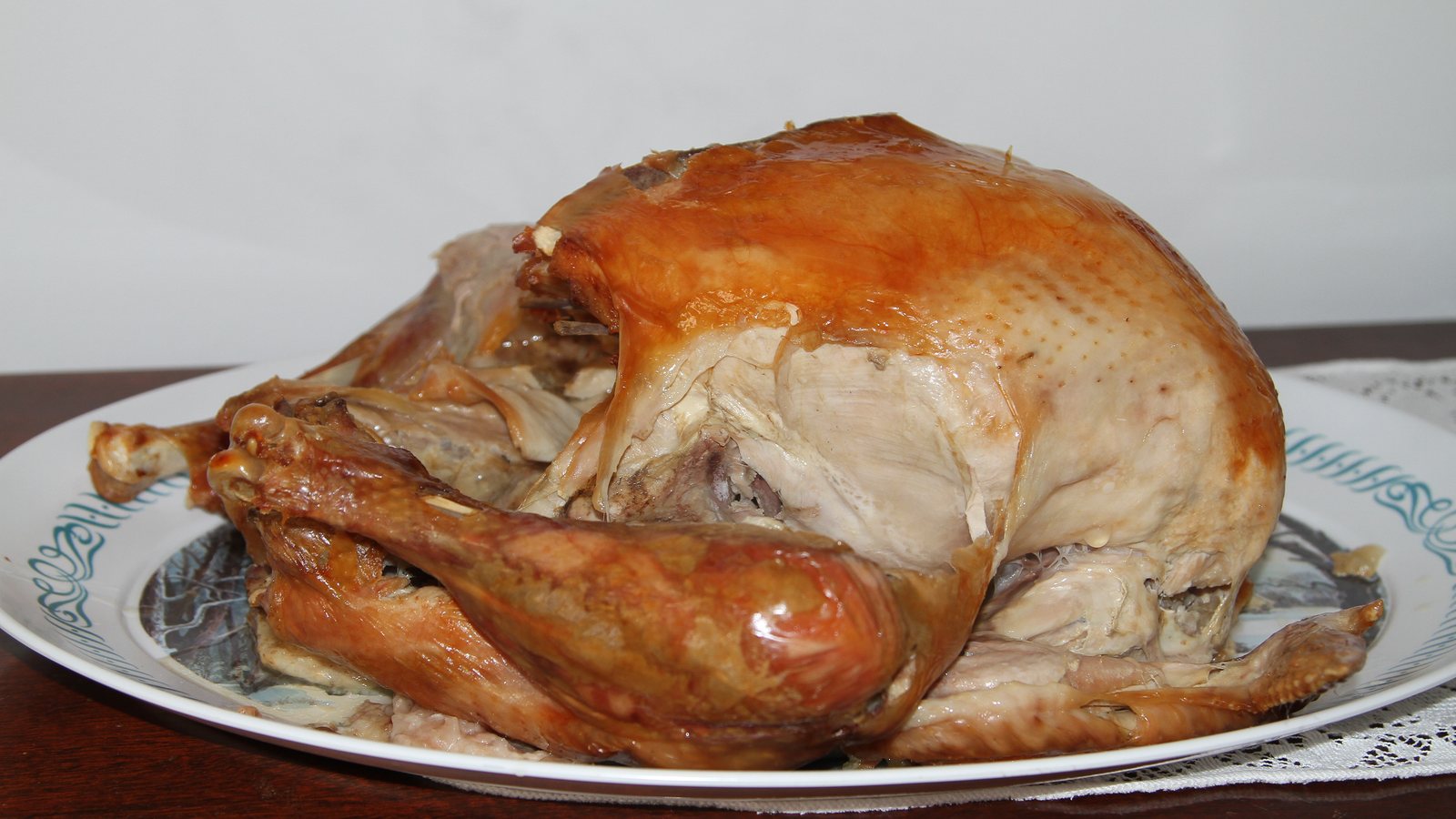
This guide summarizes publicly posted USDA, CDC and Butterball food-safety guidance. Hotline hours are as posted by each organization and can change. Featured image: homemade roast turkey on Thanksgiving Day. Photo by Jim, the Photographer via Wikimedia Commons, CC BY 2.0 (cropped).