Hackers broke into the remote controls of supermarket fridges and freezers across Europe overnight into Monday, November 2, 2026, switching units to defrost and pushing some temperatures as high as 50°C (122°F). Stores in at least 11 countries were hit, tonnes of chilled and frozen food had to be thrown away, and the European Union says the attacks were “not isolated.” No one has claimed responsibility. If you shop at an affected chain, the food that warmed up was discarded, so the main thing you may notice is gaps on the shelves for a few days.
Here is what happened, which countries and chains were affected, who might be behind it, and what the episode means for the smart appliances in your own kitchen.
What happened in the supermarket freezer cyberattacks?
According to the BBC, the attackers got into refrigeration control systems that stores use for remote monitoring and maintenance. Belgian refrigeration company Sabcobel, which makes some of the affected units, said the evaporators were switched into defrost mode, which made the cabinets warm up. In Italy, the head of the group that runs Coop-branded stores in Sicily told the news agency ANSA the attack hit “our remote-control system for frozen food sections” at about 4:00 a.m., AFP reported.
This was the second wave in a few weeks. On October 11 and 12, a similar attack disrupted as many as 700 French grocery stores and caused food losses estimated in the tens of millions of euros, the BBC said.
How did the hackers get in?
Investigators have not published a full technical report yet, but the early picture is consistent. Italian Prime Minister Giorgia Meloni’s office said the affected Italian businesses were “mostly still equipped with obsolete security systems, with interfaces directly exposed to the internet and inadequate authentication mechanisms.” Security firm SentinelOne notes that the attackers appear to have changed temperature and defrost settings through the systems’ own management interfaces, and that France’s cybersecurity agency, ANSSI, linked the October cases to internet-exposed admin panels and weak passwords.
In Sweden, Coop said the units hit in its stores were connected through older 4G networks rather than its newer 5G setup, which made them “more exposed.” In Portugal, the Mosqueteiros group said the attack “appears to have targeted an external service provider responsible for managing the refrigeration systems.”
Which countries and supermarkets were affected?
By Tuesday, November 3, Al Jazeera and AFP counted at least 11 countries. Based on those reports and the BBC’s, here is what retailers and officials have confirmed so far:
- Belgium: among the hardest hit, with dozens of stores across Delhaize, Carrefour, Colruyt and Intermarché. Carrefour Belgium said about 15 of its 700 stores were affected, and Ikea said its Mons store saw freezer temperatures rise. Federal prosecutors have opened an investigation.
- Luxembourg: four Delhaize stores.
- Ireland: 13 SuperValu stores, according to owner Musgrave Group, which said the problem was limited to a “specific model” of refrigerator.
- Sweden: seven of Coop’s roughly 800 stores, plus a small number of ICA stores. One ICA store in Sjöbo posted that its fridges and freezers had been set to 50 degrees.
- Italy: at least four Coop stores in Sicily and one business in Tuscany, with around 20 outlets reported nationwide.
- Portugal: seven Intermarché stores.
- Germany: four stores, including a Rewe store in western Germany that was affected after an attack on system provider Danfoss.
- Romania: six stores.
- Estonia, Finland and the Netherlands: a smaller number of stores and corner shops.
- United Kingdom: the National Cyber Security Centre (NCSC) said a small number of organisations may be affected, mainly in the meat supply chain rather than big supermarkets.
Who is behind the attacks?
Nobody knows yet, and officials are being careful. EU spokesman Thomas Regnier refused to point the finger at anyone but said, “These are not isolated incidents, and of course, we have to be collectively resilient and prepared for such cyber incidents.” A spokesperson for Belgium’s cybersecurity agency told Politico that “it may never be possible to identify them.”
Opinions differ among experts. One cybersecurity company chief quoted by Politico said his firm “strongly” believes a Russian state-sponsored group could be responsible, and SentinelOne calls Russian-aligned groups with a record of attacking industrial systems “a credible line of investigation” while stressing that the evidence does not establish who did it. On the other side, Romania’s top cyber official, Dan Cimpean, called the attacks “semi-amateurish” and said he did not suspect a state actor. There has been no ransom demand and no claim of responsibility.
Is supermarket food safe to buy right now?
The affected chains say they threw out the chilled and frozen stock that warmed up and are restocking. Musgrave said on Monday that “replenishment of chilled and frozen ranges in the affected stores is well under way,” and Coop Sweden said its affected shops were back to “normal functioning.” Italy’s government described the overall impact as “currently very limited.”
For shoppers, the practical effects are short-term: empty freezer cases, missing ice cream or frozen meals, or a store closing for a few hours while it cleans up. If anything you bought looks or feels like it has been thawed and refrozen, ask the store about it rather than guessing.
A useful reminder for your own freezer
The same food safety rules apply at home when a freezer fails for any reason, whether a power cut or a fault. FoodSafety.gov says a full freezer holds a safe temperature for about 48 hours (24 hours if half full) as long as the door stays closed, and food can be refrozen if it still has ice crystals or is at 4°C (40°F) or below. Its rule of thumb is simple: never taste food to check it, and when in doubt, throw it out.
Could your smart fridge at home be hacked?
The supermarket attacks targeted commercial refrigeration controls, not household appliances, and there are no reports of home fridges being affected. But the weak spots investigators describe, such as devices reachable from the internet, default or weak passwords and old software, are the same ones that put smart home gadgets at risk. The UK’s NCSC guidance on smart devices lists a few simple habits:
- Change default passwords. If a smart fridge, thermostat or camera came with a preset password, replace it. The NCSC suggests combining three random words.
- Turn on two-step verification in the device’s app if it offers it.
- Switch on automatic updates, and install manual updates when prompted.
- Turn off remote access if you don’t need to control the device when you’re away from home.
- Check the support end date before you buy. Devices that no longer get security updates are easier to hack.
For a broader look at everyday online safety, see our guides to cybersecurity in everyday life and data privacy and information security. If you are curious about where connected grocery tech is heading, our piece on smart tech in the grocery experience is a good place to start.
What happens next?
The European Commission convened its interinstitutional task force on Tuesday with law enforcement and cybersecurity agencies to work on a joint response, Cybersecurity Dive reported. The EU’s food and agriculture commissioner, Christophe Hansen, warned of possible further disruption. In the UK, the NCSC has told retailers to update the software on fridge temperature controls, and its chief, Richard Horne, said the agency had been “working through the night alerting organisations” with exposed technology. Retailers such as Coop Sweden are speeding up upgrades to newer, better-secured connections. SentinelOne expects more incidents wherever the same weak access points remain.
FAQ
When did the supermarket freezer cyberattacks happen?
The latest wave hit overnight around Monday, November 2, 2026, with more countries reporting problems on November 3. An earlier, similar attack hit French supermarkets on October 11 and 12.
How many countries were affected?
At least 11: Belgium, Estonia, Finland, Germany, Ireland, Italy, Luxembourg, the Netherlands, Portugal, Romania and Sweden, plus the United Kingdom, where a small number of food supply businesses were affected.
Has anyone claimed responsibility?
No. Investigations are under way in several countries, and officials have not attributed the attacks to any group or government.
Were home smart fridges affected?
There are no reports of household appliances being hit. The attacks targeted commercial refrigeration control systems, but basic steps like changing default passwords and keeping devices updated help protect smart appliances at home.
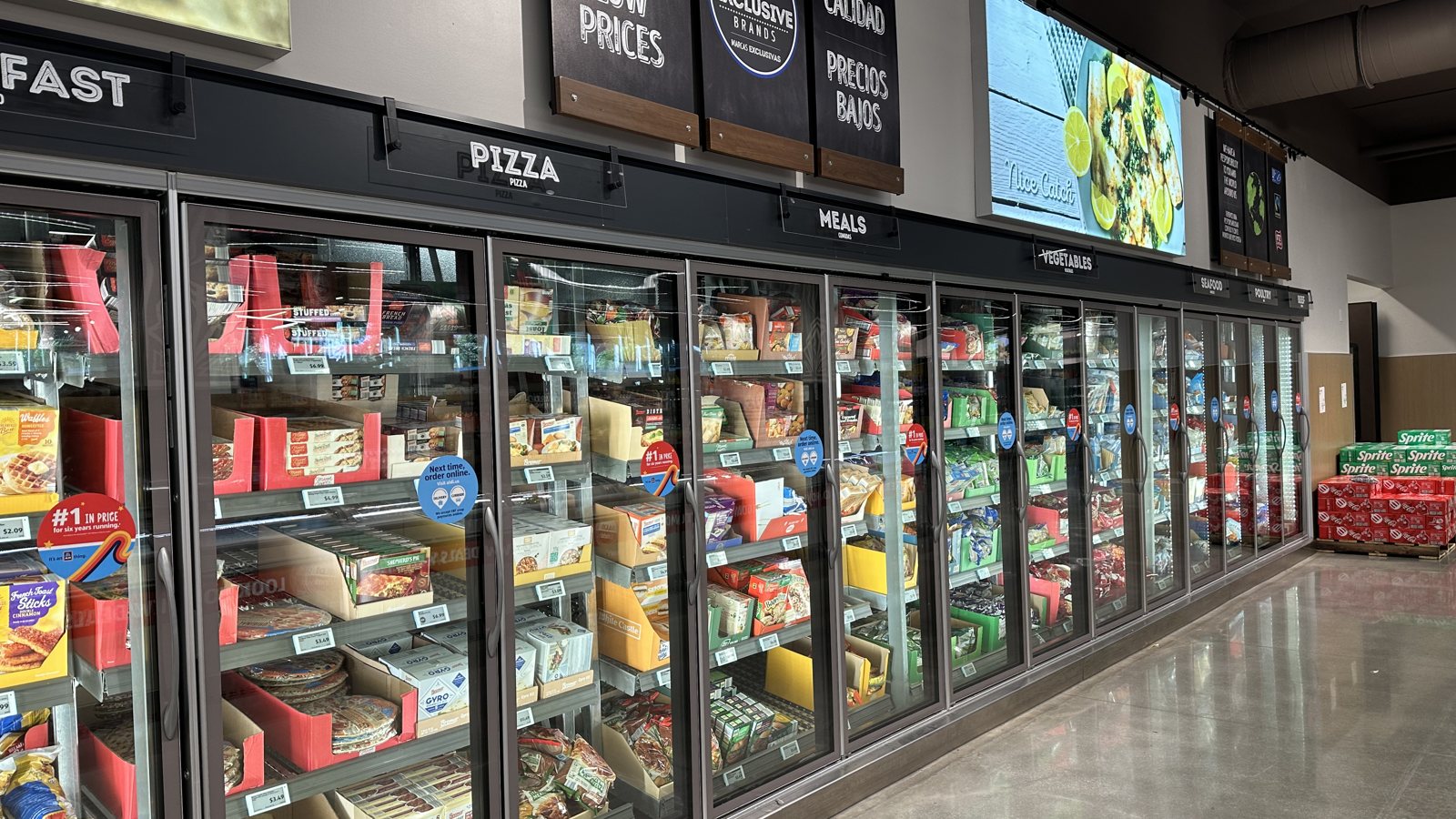
Featured image: Freezer aisle at an Aldi in Miami, Florida, by Phillip Pessar, CC BY 2.0, via Wikimedia Commons (cropped). The store pictured was not affected by the attacks.